
New Laurentia in Way of the Hunter 2: the 100 km2 North America map, its 15 species, elk and moose behaviour, need zones, tracks and hunting pressure.
Way of the Hunter 2 New Laurentia Guide: North America Map, Habit Zones and Game
New Laurentia is the North America reserve in Way of the Hunter 2: 100 km² (38 sq mi), 15 of the 28 huntable species at version 1.0, and the map the moose-behaviour investigation runs on. Infrastructure repair is a named feature too — you fix broken bridges and tunnels, restore habitats, remove pollution and clear invasive species, which the developers say feeds animal fitness. Written against Update 1.1, build 212672.
New Laurentia at a glance
| Item | Value as of v1.0 / 1.1 | Source |
|---|---|---|
| Size | 100 km² (38 sq mi) | 1.0 FAQ (EA FAQ: "a 10×10 km open-world region") |
| Species | 15 of the 28 at 1.0 | 1.0 FAQ |
| Story hook | Investigate unusual moose behaviour with a dog trainer and a former warden | Store page |
| Tracks | Dynamic between need zones; spooked animals leave temporary tracks | 1.0 FAQ |
| Weather | Per-ground long-term forecast, effective after 48 in-game hours | 1.1 notes |
| Ecosystem work | Repairs, habitat restoration, pollution and invasive-species removal, which "directly impact animal fitness" | Update 1 |
The area has never changed size — 10 × 10 km is exactly 100 km² — so any other figure is a conversion error, not an update. The maps and reserves breakdown compares all three maps; the complete species list has the full 28.
Official source: Nine Rocks Games — Way of the Hunter 2 FAQ
The 15 species, and what the patch log says about each
The FAQ gives names only; the patch notes are the official record of per-species changes.
| Group | Species | Dated official changes |
|---|---|---|
| Ungulates | Western moose, Rocky Mountain elk, Wood bison, Rocky Mountain mule deer, Northern white-tailed deer, Rocky Mountain pronghorn, Central European wild boar | Update 1 (Apr 28, 2026): moose trophy measurements added, harvest-screen stars fixed, elk trophy polished, bison values fixed |
| Predators and competitors | Grizzly bear, Northwestern grey wolf, American wolverine | None charges the player at 1.0 |
| Birds | Mallard, Eastern wild turkey, White-tailed ptarmigan | 0.3.0: mallard territories denser, living zones closer; Update 2 (May 27, 2026): ptarmigan sound cues fixed |
| Small game | Snowshoe hare | Update 1: animations, reactions, cues |
Thirteen were huntable on March 26, 2026; pronghorn and wild boar joined in Update 0.3.0 in late June.
Nine Rocks has published no need-zone times, activity windows or trot distances for any New Laurentia species. Charts like that come from player observation, not the simulation.
Six named places the developers themselves use
No public gazetteer exists, but the patch notes name six New Laurentia sub-regions, and their fixes show what is there.
| Place | What the official patch notes say |
|---|---|
| Lake Sasquatch | Missing swamp water (Update 2); viewpoint glitch (0.4.1); the "Get rid of water pollution in Lake Sasquatch" challenge, completion bug fixed in 0.3.0; tunnel to Jackalope Cordillera |
| Jackalope Cordillera | Floating rocks near the Lake Sasquatch tunnel (0.2.1) |
| Mishipeshu Swamp | Bad water texture, crater rock asset, a small lake missing from the hunting map (Update 2) |
| Wetiko Foothills | Floating rocks near a cave (Update 2); the lake to the south had water level mismatched to terrain (0.4.0) |
| Kermode Plateau | Water splitting unnaturally near the lake (Update 2); a tree misplaced on the asphalt road (0.4.0) |
| Thunderbird Muskeg | Floating texture at a hunting stand (Update 2); a cabin parking sign working from one side only (0.3.1) |
Those are the only New Laurentia place names the developers have published; need zones and campsites exist as map layers only on third-party tools such as the Shackmaps map, marked by players.
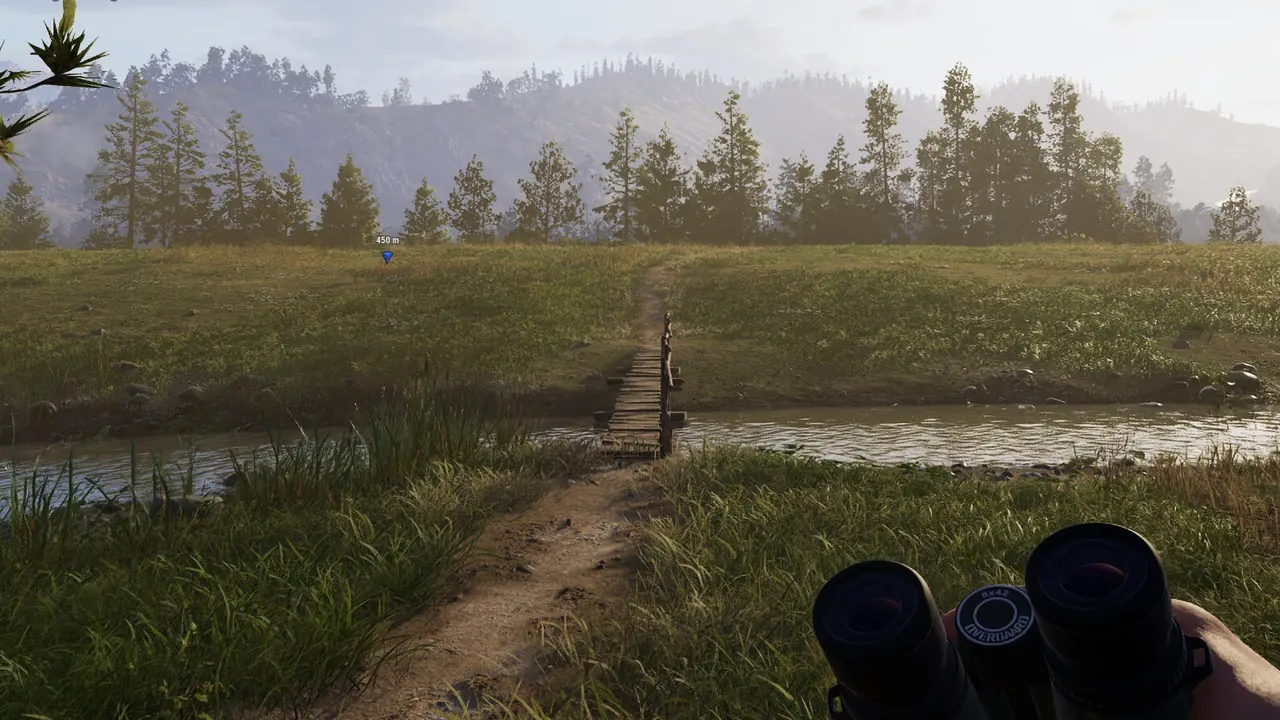
Tracks, need zones and hunting pressure
Tracks are not rails. The FAQ says they are "dynamically created between need zones", and that spooked animals "can also generate temporary dynamic tracks as they move across the map" — a moving animal, not a fixed trail.
Hunting pressure is the lever you control. Update 1 credits suppressors with "reducing animal alertness and preventing nearby herds from spooking": a system change, not a cosmetic one. The FAQ says the team wants "to support herd management as much as possible", with no numbers published. Version 1.0 added a high-contrast tracks style for Hunter Assist and animal analysis customisation, both in Settings > Game. The dog finds signs, locates active life zones and follows blood trails; advanced training is post-launch and 1.0 ships no extra breeds. Technique is in the tracking, wind and dog guide; suppressor loadouts in best weapons and ammo.
Weather you can schedule, from Update 1.1
- Set per hunting ground from the in-game menu; it "takes effect after 48 in-game hours", so a mid-hunt change will not land today.
- Snowfall likelihood is separate from animal aging, so you can queue a snow hunt without ageing the trophies you are waiting for.
- Version 1.0 added new weather options under ENVIRONMENT and fixed rain-on-grass effects and a forecast that did not refresh after sleeping.
The 48 in-game hours are the point: choose conditions, bank the time, and start the trip when your weather is running.
The rest of the 1.1 change list is in the Update 1.1 breakdown.
Ecosystem work: what repairs actually do
The clearest official statement came with Update 1 on April 28, 2026:
Players can now actively shape ecosystems through infrastructure improvements in reserves by restoring damaged habitats, removing pollution, and clearing invasive species. These efforts directly impact animal fitness and population potential.
Official source: Update 1 Is Out Now! (Steam announcement)
The Road to 1.0 post frames it around the map's damaged bridges and tunnels: "These changes are not just cosmetic or about easier navigation — some improvements will directly affect gameplay, opening new opportunities, and improving animal populations." The launch announcement repeats it, raising "the fitness potential of the local herds". Fitness feeds trophies too: Update 2 raised initial fitness across all species "for better trophy distribution", and 0.3.1 fixed fitness not affecting weight.
One community caveat: a Steam thread from May 31, 2026 has three players reporting no XP for clearing the Lake Sasquatch pollution, three invasive sites and habitat work at three sites, while the same actions on Africa paid out. A player report, untested by us — and a real 0.1.1 fix touched the same area: "Some Pollution and Enhancement information showing incorrectly affected species".
The moose investigation, and why it is not the Kilimaya story
The store page sets the hook: "In New Laurentia, investigate the unusual behavior of the local moose population with the help of a skilled dog trainer and a former warden." Africa is framed around a safari guide, an archery expert and a retired huntress, all "helping maintain the balance of the ecosystem" — same idea, different wrapper; the Kilimaya guide covers that side.
The FAQ is blunt about how much story there is: the game "combines open-world free hunting with structured missions and objectives", with "lighter story elements" for atmosphere. The patch log names missions like MooseNews and Wattle Bearers without saying which reserve they sit in — and what the "unusual behaviour" is has never been published.
What is official and what is not
| Claim | Status |
|---|---|
| 100 km², 15 species, the moose hook | Official — FAQ, store page |
| Six named sub-regions | Official — patch notes |
| Dynamic tracks between need zones | Official — 1.0 FAQ |
| Restoration raises herd fitness | Official — Update 1 |
| Weather lands after 48 in-game hours | Official — Update 1.1 |
| XP value of one restoration action; per-species need-zone times | Not published |
| "One map" / "static tracks" claims on wikis | Stale — pre-1.0 or first game |
FAQ
How big is New Laurentia? 100 km² (38 sq mi), unchanged since the March 26, 2026 Early Access launch; Kilimaya matches, Hearth & Hunt Headquarters is 16 km².
Are the tracks dynamic? Yes, per the 1.0 FAQ — created between need zones, plus temporary tracks from spooked animals. First-game guides still call them static, describing the original game.
Can animals attack me in New Laurentia? No species there has charge behaviour at 1.0; the three charging species — southern lion, hippopotamus and Cape buffalo — are all in Kilimaya.
Can I set the weather? Yes, from Update 1.1: a per-ground forecast effective after 48 in-game hours, snowfall separate from animal aging.
Do repairs really change the hunt? The developers say restoration "directly impact[s] animal fitness and population potential". No per-action numbers are published, so the link is official but its scale is not.
Related Guides
More Way of the Hunter 2 Guides
Kilimaya Reserve in Way of the Hunter 2: the 100 km2 Africa map, its 13 species, which predators can charge you, and how to hunt hippo and buffalo safely.
Way of the Hunter 2 known issues after launch: the demo config fix for broken resolution settings, plus how to report a bug.
All 3 Way of the Hunter 2 maps with exact sizes: New Laurentia and Kilimaya at 100 km2 each, Hearth & Hunt at 16 km2. What each holds.
How to play co-op in Way of the Hunter 2: how to invite a friend, open a lobby, join a session, and the 2-player limit that trips people up at launch.
Way of the Hunter 2 update 1.1 summary: weather forecast, inverted look, controller deadzone fixes, what is still broken, and how to report bugs.
Way of the Hunter 2 costs $39.99 or $59.99 deluxe. What the 8-DLC Season Pass adds, what Heirloom Pack includes, and how game 1 owners save.
Way of the Hunter 2 Season Pass: 8 DLCs in year one, $34.99, release window, what is inside right now, and the three statues that prove it worked.
Way of the Hunter 2 on Steam Deck: the developer says it is not officially supported. What happens when you try, and whether it is worth it.